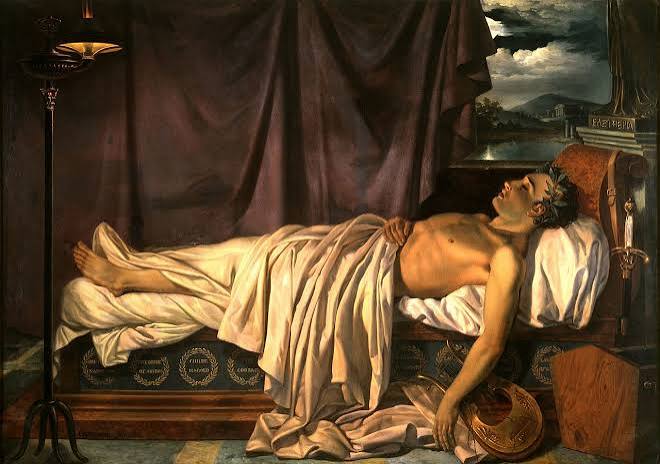
Literary historians have understood the Romantic period as erupting out of major social and political upheavals from the French, American, and Haitian Revolutions and Napoleonic Wars to the end of transatlantic slave trade (1807, 1833) and the growth of the British colonial project. More recently, scholars add to these critical contexts the effects of anthropogenic climate change, fueled by the rapid industrialization of Europe and the extraction imperatives of empire. In these contexts, Romantic authors began to imagine “the end of the world” from visions of apocalypse such as Lord Byron’s “Darkness” and Mary Shelley’s The Last Man to the stark realities of loss on both personal and national scales found in Jane Austen’s Persuasion and Thomas De Quincey’s Suspiria de Profundis and The English Mail Coach. This course asks students to think Romantic Disasters and the “end of the world” through tropes of interpersonal love and loss, analyzing how these love stories and the love stories we tell double and refract anxieties about the natural and manmade “disasters” Romantic authors also lived through. At the same time, students will consider how love and loss as Romantic tropes survive the period, extending to authors and works who reckoned with the same questions about life beyond disaster, from George Eliot’s Daniel Deronda to Oscar Wilde’s De Profundis. Some but not all of these texts will appear on the syllabus this year.
By bringing attention to the intersections of love and loss, students will explore how this critical intersection animates the ways in which we imagine the “disasters” of our own times as well as the necessity of hope and survival beyond the ends of the world we conjure. Theoretical selections may include Sigmund Freud, Barbara Johnson, Jacques Lacan, DA Miller, Adela Pinch, Grace Lavery, Saree Makdisi, and Mari Ruti
Assignments
Annotations (20%)
Annotations will provide the professor with additional evidence of your careful reading of the course materials (beyond your participation and written work). Writing directly on the printed page is also part of the thinking process, leading to better reading comprehension, clearer understanding of key ideas, and more nuanced thoughts about the course material. Annotations also help create reading behaviors that can help with attentional challenges. Read everything with a pen ready to hand to facilitate these critical professional skills.
Students are expected to come to class with print copies of all readings, complete with annotations and notes. These will be collected after each class period. Annotations will be assessed on the following scale:
| Check + | Every page has annotations that track not only plot points or reactions but also major theoretical ideas we have discussed in class in relation to the text or previously in other conversations. |
| Check | Every page has annotations that track mainly plot points and reactions. Few connections to other readings and limited marginal notes. |
| Check – | Some pages are annotated but many are blank. There are notes in the margins but they do not make connections or track plot as much as react to the story. |
| 0 | Some pages are annotated but many are blank. No note in the margins. |
Crux Buster (15%)
This close reading assignment asks you to take a piece of text– a passage of no fewer than ten sentences– and analyze it. Your close reading should clearly state your interpretation of the passage, noting how it is narrated, what language it uses, how the language informs the ways we interpret it, and what meanings this arrangement of language necessarily implies. Close reading is slow reading but it is also attentive reading that discovers how a text means and the varieties of meanings that we might derive from it beneath surface-level summary or interpretation.
Crux Buster 2 (15%)
This close reading assignment asks you to take a piece of text– a passage of no fewer than ten sentences– and analyze it. Your close reading should clearly state your interpretation of the passage, noting how it is narrated, what language it uses, how the language informs the ways we interpret it, and what meanings this arrangement of language necessarily implies. Close reading is slow reading but it is also attentive reading that discovers how a text means and the varieties of meanings that we might derive from it beneath surface-level summary or interpretation.
Final Paper Proposals, Preliminary Bibliography, and Discussion (15%)
For the final, you will have to write a proposal. You will not be graded on the written content of the proposal, but on your discussion with me in person of it. While the proposal itself is not the most complex genre, I am looking for the following qualities in our discussion:
- a focused research topic that helps to explore Middlemarch and the affordances of the novel as a genre
- detailed plan for interpreting specific passages of text or moments in the novel that give you insight into this topic
- ability to explain why this project is important to you and your interests in literary studies
- a preliminary bibliography of 3-5 sources with annotations
You must meet with a research librarian to complete the assignment and me to discuss your findings. The librarian will help you find sources, and the discussion with me will assess your knowledge and understanding of the sources you have selected. The grade will be assigned not on the written work but on the quality of our discussion about the sources you have found.
Draft Meeting and Defense (5%)
The last week two weeks of class will be dedicated to draft meetings. Each student will meet with me one on one to discuss their progress on their final essay. Students should have drafted no fewer than 5 pages for this meeting. The final paper is 10-12 pages. The discussion will require the student to assert their argument, explain their examples, and pose questions about how they have organized or plan to revise it. I am not looking for perfection. In fact, mess is always welcomed. I am looking for meaningful intellectual engagement in the topic.
Final Paper (10%)
The final paper will be assessed as a piece of writing. Any use of AI on this final or any portion is strictly prohibited because it defeats the purpose of the assignment: to learn how to read, write, and use theory in your own words. If I expect AI, I reserve the right to assign you a 0 for the paper, and I will not let you rewrite it.
Preparation, Participation, Attendance (20%)
Your participation in this seminar style class is imperative. Be prepared to participate and attend class every day. If you are not prepared for discussion and participation, I consider this to be a form of absence.
Learning Outcomes
This course fulfills these learning goals for the English Major and Minor. Students will:
Consider the role of novel reading and realism in the production of Victorian social values as well as the ethical imperatives Eliot ties to art and literature..
Read slowly, carefully, and closely.
Attend to the relationships among poetry, novels, and theory.
Situate arguments in a larger critical conversations and historical contexts.
Analyze the relationship between love and loss as they are expressed historically and conceptually.
Write thoughtful interpretations and arguments about the novel.

